

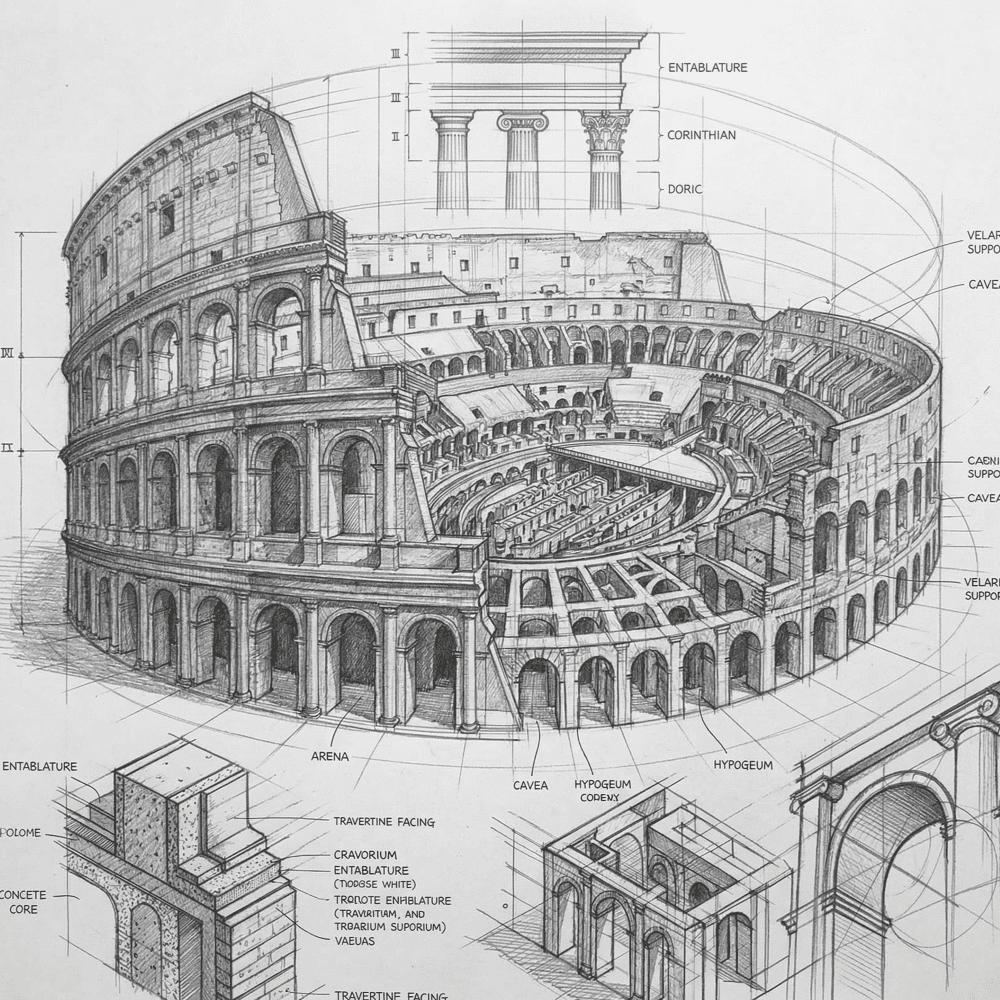
In the modern world of “lean startups” and “agile pivots,” we often treat brand identity as something fluid—a digital skin that can be swapped out with a CSS update.
But history tells a different story. The most enduring organizations in human history—empires, religions, and guilds—understood a fundamental truth: An idea does not truly exist until it is set in stone.
From the Pyramids of Giza to the Roman Colosseum, great structures weren’t just functional spaces; they were “visual clues” of an organization’s power, stability, and longevity. For the modern industrial giant, the lesson is clear: Branding isn’t just a logo; it’s the architecture of your myth.
1. The Colosseum: Branding Through Scale
When the Flavian emperors built the Colosseum, they weren’t just building an arena. They were rebranding Rome after a period of chaotic civil war.
The sheer scale of the stone, the repetitive perfection of the arches, and the advanced engineering required to manage 50,000 spectators acted as a visual shorthand for “The Empire is back, and it is organized.” It was a physical manifestation of the Roman “brand”—disciplined, massive, and permanent.
The Industrial Parallel: When a renewable energy company builds a massive, sleekly designed battery storage hub, they are doing the same thing. They are moving the idea of “clean energy” from a theoretical PowerPoint slide to a physical monument of reliability.
2. The Pyramids: Signaling Perfection and Eternity
The Pyramids are perhaps the most successful “brand assets” in history. Their geometry is a visual clue for mathematical perfection and eternal stability. By setting their ideas in such a precise, unmovable form, the Pharaohs ensured that their “organization” (the state) was viewed as divinely sanctioned and invincible. You didn’t need to read hieroglyphics to understand the message; the silhouette against the horizon told you everything you needed to know.
The Industrial Parallel: In robotics and drone surveying, precision is your “divine sanction.” Your brand’s visual form—your hardware’s industrial design and your software’s UI—must echo that same geometric obsession. It signals to the client that your data is as unshakeable as stone.
3. Building the Myth Around the Brand
Why does this matter for a drone company or a grid operator in 2026?
Because humans are still biologically wired to look for visual “proof” of an idea’s weight. An industrial brand that lacks a strong, cohesive visual structure feels “light.” It feels like it could blow away in the next market shift.
To build a “myth” around your brand, you must move beyond the transactional and into the monumental:
-
Consistency as Foundation: Just as every Roman temple followed a specific order (Doric, Ionic, Corinthian), every touchpoint of your brand must follow a rigorous logic. This creates the feeling of an “Established System.”
-
Materiality: In the industrial world, the “form” includes your physical assets. The way your drones are painted, the way your technicians dress, and the way your factory floor is laid out are all “stones” in your monument.
-
The Silhouette: Does your brand have a recognizable “shape”? Great historical icons are recognizable by their outline alone. Your technology should be, too.
Conclusion: Stop Designing, Start Building
The Colosseum and the Pyramids survived because they were built with the intent to last. They transformed abstract power into a physical reality that couldn’t be ignored.
In the industrial sector, you aren’t just selling a service; you are selling the future of infrastructure. Your visual identity shouldn’t just be a “graphic design project.” It should be the blueprint for your legacy. Set your ideas in a visual form that commands the same respect as the monuments of old.